Data Science : Features of Python Programming Language

Features of Python Programming Language
Python Features

1.Easy

Easy to code :

Python is extremely easy to code. Compared to other popular languages like Java and C++, it’s easier to code in Python. Anyone can learn Python syntax in only a couple of hours. Though sure, mastering Python requires learning about all its advanced concepts and packages and modules. That takes time. Thus, it’s programmer-friendly language.

Easy to read :

Being a application-oriented language, Python code is sort of like English. looking at it, you’ll tell what the code is meant to try and do. Also, since it’s dynamically-typed, it mandates indentation. This aids readability.

2. Expressive

First, let’s study expressiveness. Suppose we have two languages A and B, and every one programs which will be made in B using local transformations. However, there are some programs which will be made in B, but not during a, using local transformations. Then, B is claimed to be more expressive than A. Python provides us with a myriad of constructs that help us specialize in the answer instead of on the syntax. this can be one among the outstanding python features that tell you why you should learn Python.

3. Free and Open Source

Firstly, Python is freely available. you’ll download it from the Python Website. Secondly, it’s open-source. this suggests that its source code is out there to the general public. you’ll download it, change it, use it, and distribute it. this can be called FLOSS(Free/library and Open Source Software). because the Python community, we’re all headed toward one goal- an ever-bettering Python.

4. High-Level

It’s a application-oriented language. this suggests that as programmers, we don’t need to remember the system architecture. Nor can we need to manage the memory. This makes it more programmer-friendly and is one among the key python features.

5. Portable

Let’s assume you’ve written a Python code for your Windows machine. Now, if you would like to run it on a Mac, you don’t need to make changes to that for an equivalent. In other words, you’ll take one code and run it on any machine, there’s no need to write different code for various machines. This makes Python a transportable language. However, you want to avoid any system-dependent features during this case.

6. Interpreted

If you’re aware of any languages like C++ or Java, you want to first compile it, then run it. But in Python, there’s no need to compile it. Internally, its source code is converted into an instantaneous form called byte code. So, all you would like to try and do is to run your Python code without fear about linking to libraries, and many other things. By interpreted, we mean the source code is executed line by line, and not all directly. due to this, it’s easier to debug your code. Also, interpreting makes it just slightly slower than Java, but that doesn’t matter compared to the advantages it’s to supply.

7. Object-Oriented

A programming language which will model the real world is claimed to be object-oriented. It focuses on objects and combines data and functions. Contrarily, a procedure-oriented language revolves around functions, which are code that may be reused. Python supports both procedure-oriented and object-oriented programming which is one among the key python features. It also supports multiple inheritances, unlike Java. a category may be a blueprint for such an object. it’s an abstract data type and holds no values.

8. Extensible

If needed, you’ll write a number of your Python code in other languages like C++. This makes Python an extensible language, meaning that it can be extended to other languages.

9. Large Standard Library

A software isn’t user-friendly until its GUI is formed. A user can easily interact with the software with a GUI. Python offers various libraries for creating Graphical interface for your applications. For this, you’ll use Tkinter, wxPython or JPython. These toolkits allow you for straightforward and fast development of GUI.

10. Dynamically Typed

Python is dynamically-typed. this suggests that the sort for a worth is set at run-time, not before. this is why we don’t need to specify the sort of knowledge while declaring it.

Machine Learning Introduction : All The Essential Concepts For Data Science

We have seen Machine Learning as a buzzword for the past few years , lets find the reason behind it.Have you ever gone grocery shopping ? What do you do before getting to the market? I always prepare a listing of ingredients beforehand. Also, I make the choice according to the previous purchasing experience. 

Then, I’m going to buy the items. But, with the rising inflation, it’s not too easy to figure within the budget. I actually have observed that my budget gets deviated plenty of times. This happens because the shopkeeper changes the quantity and price of a product fairly often . due to such factors, I even have to switch my shopping list. It takes tons of effort, research and time to update the list for each change. this is often where Machine Learning can come to your rescue.    

Machine Learning Introduction

In today’s world, Machine Learning is the most important and demanding technology in all the fields. So what is Machine Learning ? Machine Learning is basically a term in which the systems have the ability to independently find solutions to a particular problem with the help of input data and already stored patterns in database which is known as training dataset. In Machine Learning the patterns are recognised on the basis of existing algorithms and input datasets. Machine Learning is a sub-part of Artificial Intelligence. For example:Machine Learning process works similar to the human learning process. A child can recognise the objects and can differentiate each object with its size, shape and colour. Similarly Machine Learning makes the use of different patterns and algorithms.

What is Machine Learning ?

Machine learning is an application of artificial intelligence (AI) that provides systems the ability to automatically learn and improve from experience without being explicitly programmed. Machine learning focuses on the development of computer programs that can access data and use it learn for themselves.

The process of learning begins with observations or data, such as examples, direct experience, or instruction, in order to look for patterns in data and make better decisions in the future based on the examples that we provide. The primary aim is to allow the computers learn automatically without human intervention or assistance and adjust actions accordingly.

Why Use Machine Learning ?   

        Machine Learning is very important in today’s evolving world for the needs and requirements of people. And it demands will always increase in the future. Machine Learning has revolutionized in the industries like banking, healthcare, medicine and several other industries of  the modern world.Data is expanding exponentially and so as to harness the power of this data, added by the huge increase in computation power, Machine Learning has added another dimension to the way we perceive information. Machine Learning is being utilized everywhere. The electronic devices you employ , the applications that are a part of your lifestyle are powered by powerful machine learning algorithms.Furthermore, machine learning has facilitated the automation of redundant tasks that have removed the necessity for manual labour . All of this is often possible because of the huge amount of knowledge that you simply generate on a day to day . Machine Learning facilitates several methodologies to form sense of this data and supply you with steadfast and accurate results. 

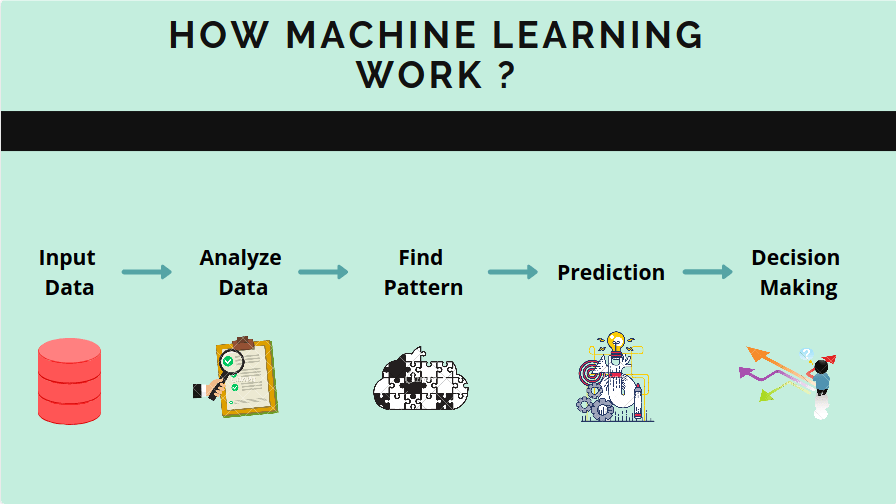
How does Machine Learning work?          

Machine Learning works with generation of predictions.    

  • Input Data
  • Analyse Data
  • Find Pattern
  • Predection
  • Decision making

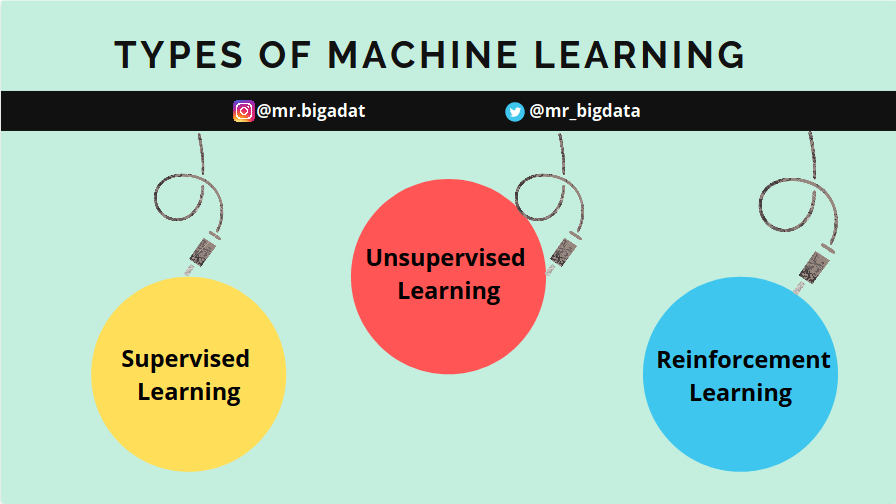
Types Of Machine Learning Algorithm     

In Supervised Learning, the dataset on which we train our model is labeled.there’s a transparent and distinct mapping of input and output. based on the instance inputs, the model is in a position to get trained within the instances. An example of supervised learning is spam filtering. based on the labeled data, the model is in a position to work out if the data is spam or ham. this is often a better form of training. Spam filtering is an example of this kind of machine learning algorithms. 

  • Unsupervised Learning                               

In Unsupervised Learning, there’s no labeled data. The algorithm identifies the patterns within the dataset and learns them. The algorithm groups the info into various clusters supported their density. Using it, one can perform visualization on high dimensional data.One example of this sort of Machine learning algorithm is that the Principle Component Analysis. Furthermore, K-Means Clustering is another sort of Unsupervised Learning where the info is clustered in groups of an identical order. The learning process in Unsupervised Learning is solely on the idea of finding patterns within the data.After learning the patterns, the model then makes conclusions.                                                                                                            

  • Reinforcement Learning                               

In programming robots to perform autonomous actions. it’s also used in making intelligent self-driving cars. allow us to consider the case of robotic navigation. Furthermore, the efficiency are often improved with further experimentation with the agent in its environment. This the most principle behind reinforcement learning. There are similar sequences of action during a reinforcement learning model.  

List of Common Machine Learning Algorithms :

  1. Linear Regression
  2. Logistic Regression
  3. Decision Tree
  4. SVM
  5. Naive Bayes
  6. kNN
  7. K-Means
  8. Random Forest
  9. Dimensionality Reduction Algorithms
  10. Gradient Boosting algorithms
    1. GBM
    2. XGBoost
    3. LightGBM
    4. CatBoost

In this machine learning tutorial, we went through the fundamentals of machine learning and how computing power has evolved over time to accommodate advanced machine learning algorithms. Computers are gaining intelligence due to the info that’s generated during a vast amount. We went through the various types of machine learning algorithms and further took a quick check out some of the popular ML algorithms. We hope that you simply are now well familiar with machine learning.   

Confused MUCH?  Don’t worry! Read this Mr.Bigdata latest Machine learning tutorial to get deep insight and understand why machine learning is trending.